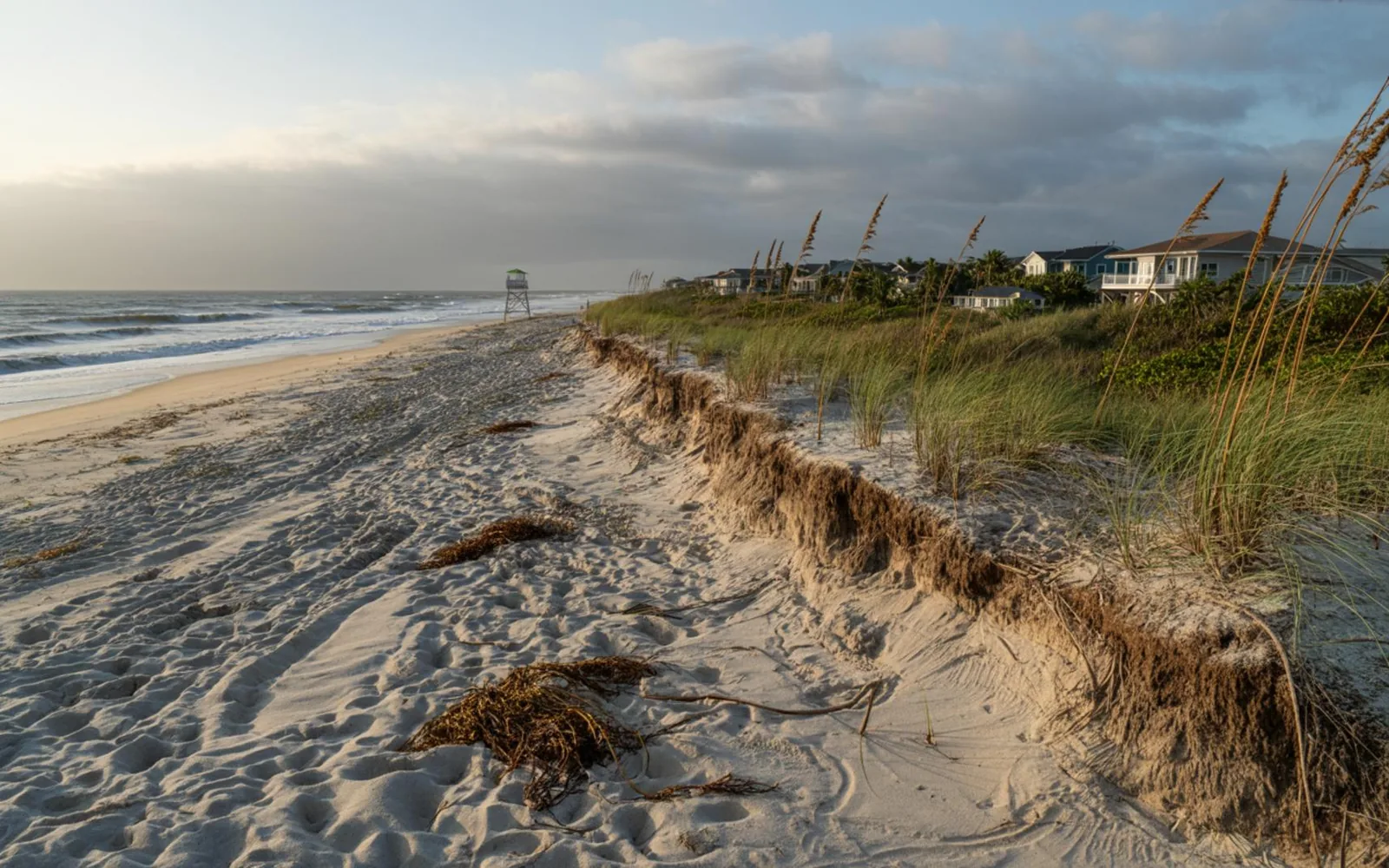
A 2025 Florida Department of Environmental Protection report reveals that nearly Jupiter Island's entire coastline faces critical erosion, endangering infrastructure, ecosystems, wildlife and archaeological sites. The assessment found the island's 11.5-mile shoreline has deteriorated so severely that ocean water could break through at Peck Lake, potentially dividing the barrier island in two. The threat extends from Blowing Rocks Preserve to Peck Lake, where a breakthrough would transform a narrow land strip into an open inlet. This scenario has historical precedent. A storm breached Peck Lake in the early 1960s before the U.S. Army Corps of Engineers restored it with sand fill. Mark Perry from the Florida Oceanographic Society warns that another breach would destabilize ecosystems requiring a precise balance between fresh and saltwater to function. He also notes the consequences reach far beyond the shoreline itself.

The stakes include significant natural and cultural resources. The Joseph Reed Mound, an archaeological site dating back 3,000 to 4,000 years, has already lost half its mass to erosion. Wildlife refuges at risk include Blowing Rocks Preserve, Hobe Sound Wildlife Refuge, and St Lucie Inlet Preserve State Park. Perry points out that over 33 threatened and endangered species inhabit these areas. A separate state assessment indicates erosion threatens mangrove swamps essential for habitat and coastal defense, while elevated water levels could displace entire species across the island. Perry emphasizes that sea levels have risen since the 1950s and have accelerated over the last 15 years, requiring collaborative approaches to address the problem.

Jupiter Island Commissioner Marshall Field confirmed the town battles erosion through continuous maintenance efforts. In April 2025, the community completed a substantial beach renourishment initiative, adding sand equivalent to filling nearly 400 Olympic-sized pools. While oceanfront homes face no immediate danger, Field stressed this security depends entirely on ongoing maintenance work. He characterized the current approach as repeatedly applying a temporary solution. About $3 million in local taxpayer funding supports beach renourishment annually. Field cautioned that a potential breach would demand significant state and federal investment for repairs. He indicated the recent FDEP assessment strengthens Jupiter Island's position to secure state and federal funding for erosion mitigation efforts.

Field emphasized that sustained funding remains uncertain. He warned that discontinuing beach renourishment support would trigger rapid and widespread coastal changes across Florida that residents would likely regret. The island's future depends on maintaining this investment in protective measures.