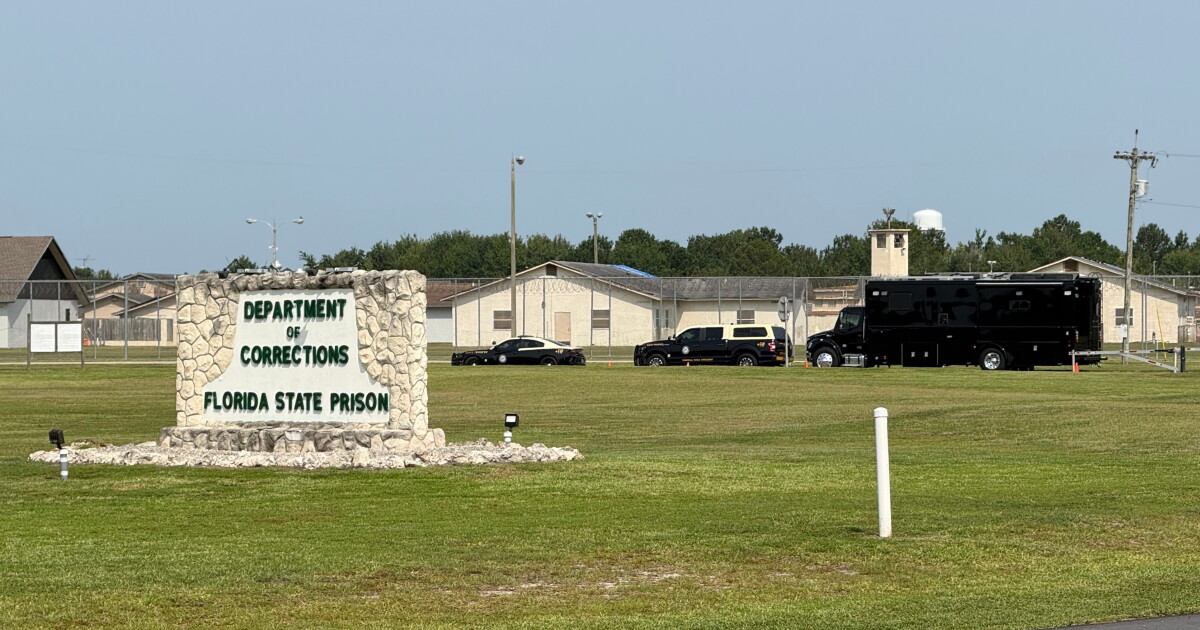
Florida carried out the execution of James Robertson on Tuesday, while Gov. Ron DeSantis withdrew a death warrant for a separate death row inmate, William Lee Thompson, in what records show is the first such withdrawal in state history. Robertson, 63, received a three-drug lethal injection at Florida State Prison near Starke starting at noon. He had pleaded guilty to first-degree murder and waived all appeals in the 2008 strangling of his cellmate, Frank Hart, telling investigators the killing was unprovoked and that he wanted to be sentenced to death rather than serve out his prison term.
Robertson was supposed to be one of two prisoners executed Tuesday, but DeSantis withdrew Thompson's death warrant last week without giving a reason. The governor had previously issued a temporary stay of Thompson's execution last month pending a psychiatric evaluation. The withdrawal does not change Thompson's sentence.
He remains on death row, and a new warrant could be signed for him in the future. DeSantis is the third Florida governor to sign a death warrant for Thompson, following Bob Graham and Bob Martinez in the 1980s, when years of appeals and stays spared him from Florida's electric chair. Thompson, 74, was convicted of first-degree murder, kidnapping and sexual battery in the 1976 killing of 23-year-old Sally Ivester. His attorneys say he suffers from dementia and failing health and have asked that he be moved to a facility equipped to provide adequate medical care.
According to court records, Robertson was incarcerated at Charlotte Correctional Institution, north of Fort Myers, when he tied together several socks and strangled Hart while Hart slept in December 2008. Robertson first went to prison in 1980 at age 17 for burglary and assault, and subsequent convictions for escape, battery and weapons offenses extended his sentence over the years.
Hart had been sent to prison in 2003 following a sexual battery conviction. Robertson pleaded guilty, waived the penalty phase that would have let a jury weigh a death sentence or life in prison, and was sentenced to death by a judge. He later waived all post-conviction proceedings and told a judge earlier this month that he understood his execution date and did not want to pursue appeals to the Florida Supreme Court or U.S. Supreme Court.
Floridians for Alternatives to the Death Penalty said the case shows the death penalty can drive violence rather than deter it. The group's legal and policy director, Maria DeLiberato, said in a statement that Hart deserved to be safe in state custody and that his loved ones deserve compassion.
Robertson's execution was the 17th in Florida this year, with two more already scheduled, not counting Thompson. William Reaves, 77, is set to be executed Oct. 20 for fatally shooting a deputy in 1986. Jesse Guardado, 64, is scheduled for execution in November for robbing and killing a woman in 2004 to buy drugs. If both executions proceed as planned, Florida would match its 2025 total of 19 executions, the most by any Florida governor in a single year since the death penalty was reinstated in 1976, with eight weeks still remaining in 2026.
Only one other Florida inmate remains alive after DeSantis signed a death warrant for him. James Dailey, 80, was scheduled to die in late 2019 for the murder of a 14-year-old girl, but a federal judge halted the execution amid arguments over his guilt. The stay was later lifted, but DeSantis has not signed a new warrant for Dailey.
DeSantis has said his goal is to bring justice to victims' families who have waited decades for death sentences to be carried out, saying he would not proceed if he believed someone was innocent. Florida carried out more than half of the 30 executions nationwide last year and in July became the first state in nearly a decade to execute two prisoners in a single day.