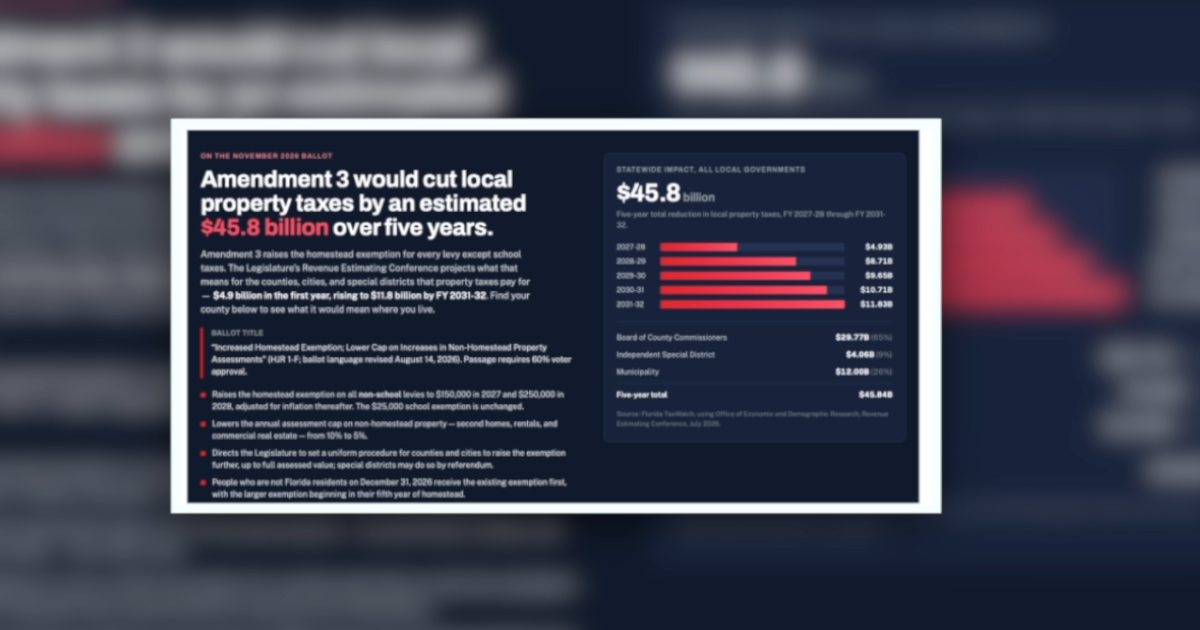
Florida TaxWatch launched an online resource center Friday to help voters understand Amendment 3, a property tax measure on the November ballot that would cut local property tax revenue by an estimated $45.8 billion over five years. The Florida Property Tax Resource Center includes an interactive county map, local millage rates, frequently asked questions and estimates showing potential revenue losses for local governments across the state.
Amendment 3 would expand Florida's homestead exemption for non-school property taxes to $150,000 in 2027 and $250,000 in 2028. School property taxes would remain unchanged. The proposal would also reduce the annual assessment-growth cap on non-homestead properties, including rental homes, second homes and commercial properties, from 10% to 5%. The measure must receive at least 60% support from voters to become part of the Florida Constitution.
Florida TaxWatch has not yet taken an official position on the amendment. President and CEO Jeff Kottkamp said the organization will announce its recommendation in a broader constitutional amendment guide expected next month. The new resource center does not include a calculator showing how much individual homeowners could save because cities and counties could respond to the revenue loss by cutting services, increasing millage rates or imposing new fees and special assessments, according to TaxWatch.
Opponents of the amendment argue the proposal would shift costs rather than eliminate them, potentially forcing communities to reduce spending on police, firefighters, emergency medical services, libraries and other local programs. Jackson Peel with Save Our Services said Amendment 3 is a scam and a tax shift that will either raise costs or take away services Floridians rely on.
The ballot summary was recently rewritten after a Leon County judge found the Legislature's original wording biased and misleading. A private calculator created by Casey Vockell of My Exemption Check found that a Hillsborough County home assessed at $500,000 could save less than $209 per month by 2028, though the estimate does not account for any later decisions by local governments.